

PHP Upgrade Cost: Moving From PHP 5 or 7 to PHP 8
Contents6
Key takeaways
- The cost of a PHP upgrade depends on how old your PHP is, how large the system is, and whether it has a framework and documentation.
- Patching within a branch is a small job. Moving from PHP 5 or 7 to PHP 8 means code changes and testing.
- PHP 8.2 support ends on 31 December 2026. For a long life, target 8.4 or 8.5.
- A reliable quote starts with an assessment, and a phased plan keeps each step affordable.
"How much will it cost to upgrade our PHP system?" Since the critical PHP vulnerabilities of October 2026, this is the question we hear most.
The honest answer: the cost of a PHP upgrade depends on how old your PHP is, how large the system is, and whether it uses a framework and has documentation. Patching within the same branch is a small job. Moving from PHP 5 or 7 to PHP 8 means code changes and testing, so it takes more time and budget. This article explains what drives the estimate and how to commission the work.
Why upgrade PHP now?
Two reasons: critical vulnerabilities have been found, and old PHP versions and frameworks no longer get fixes.
Support deadlines and the events of October 2026
PHP 7.4 reaches end of life
The last 7.x release. No fixes since.
PHP 8.1 reaches end of life
Every version up to 8.1 is now unsupported.
Laravel 11 security fixes end
CakePHP 4 reaches end of life
CakePHP 2 and 3 were already unsupported.
Fixes for the critical "PHP2shell" vulnerabilities
Released on 21 October (CVE-2026-109618, CVE-2026-109619); IPA and JPCERT/CC issued alerts on the 22nd. See what to do about the PHP2shell vulnerabilities.
PHP 8.2 reaches end of life
Fine today, out of support by the end of the year.
Laravel 12 security fixes end
Which version should you target?
| Version | Supported until | Status (October 2026) |
|---|---|---|
| PHP 8.5 | 31 Dec 2029 | Recommended |
| PHP 8.4 | 31 Dec 2028 | Recommended |
| PHP 8.3 | 31 Dec 2027 | Supported |
| PHP 8.2 | 31 Dec 2026 | Ending soon |
| PHP 8.1, 8.0 | 31 Dec 2025, 26 Nov 2023 | End of life |
| PHP 7.4 and older, 5.x | 28 Nov 2022 or earlier | End of life |
For a long life, choose 8.4 or 8.5
If you are upgrading anyway, a version with a later end date buys you more time before the next big job. As of October 2026, versions 8.2 to 8.5 are supported.
Patch vs upgrade
The words sound alike, so let's be precise.
| Work | What it means | Size |
|---|---|---|
| Patch (minor update) | Latest release of the same branch, e.g. 8.3.20 → 8.3.36 | Small Mostly testing |
| PHP upgrade | Move to a newer branch, e.g. 7.4 → 8.4, fixing code that no longer works | Medium to large |
| Framework upgrade | Newer Laravel or CakePHP; leaving CakePHP 2 can be close to a rewrite | Medium to large |
| Server / OS migration | Move off an unsupported OS (such as CentOS 7) to a new environment | Medium |
Most projects end up renewing PHP, the framework and the server together.
Keep patching only
- PHP 8.1 and older get no regular fixes at all
- PHP 8.2 runs out on 31 December 2026
- The same worry returns with every new vulnerability
Upgrade to PHP 8
- You receive fixed releases again
- 8.4 or 8.5 stay supported until the end of 2028 or 2029
- Future vulnerabilities become routine patches
Five factors that drive PHP upgrade cost
| Factor | Cost goes up when… | Cost stays down when… |
|---|---|---|
| 1. Version gap | The jump is large, e.g. PHP 5 to 8 | The jump is small, e.g. 8.1 or 8.2 to 8.4 |
| 2. System size | Many screens, features and integrations (payments, email, accounting) | The scope is focused |
| 3. How it was built | Custom code without a framework, or abandoned libraries | Built on a widely used framework such as Laravel |
| 4. Documentation and tests | No specifications and no automated tests, so more manual checking | Specifications or automated tests exist |
| 5. Server environment | The OS and database are out of support too and need migrating | The server is current; only PHP needs upgrading |
Be wary of "typical prices" online
The five factors above change the amount of work completely, so a price found online can mislead. A reliable quote starts with an assessment of the actual code.
Ways to keep the cost down
The most effective one: don't do everything at once, split it into phases.
- Drop what nobody uses: unused screens and features can be removed instead of migrated.
- Work in phases: security mitigation first, then PHP, then the framework.
- Agree the test scope together: focus on features that drive revenue and daily operations.
From request to go-live
- Consultation
What the system does, who uses it and what is going wrong.
- Assessment
We review the source code, server, database and libraries.
- Plan and quote
Options for how far to upgrade and in what order.
- Changes and testing
In a staging environment separate from production.
- Go-live
Minimal downtime, with a rollback plan ready.
- Maintenance
Ongoing PHP updates and fixes for new vulnerabilities.
What to prepare
Contract details
Who holds the server and domain contracts.
The source code
On the server is fine.
Any documents left
Old specifications, quotes, screen notes, emails.
The people who use it
Who uses each feature, and what they do most.
You can commission the work without documentation. If the original developer is gone or the expert has left, see taking over a system with no documentation.
Questions to ask about any quote
- Which versions will PHP, the framework and the OS end up on?
- Who tests, and how much?
- Can go-live be rolled back if something goes wrong?
- Who handles bugs afterwards, and the next vulnerability?
FAQ
How long does it take?
A patch is quick. A move from PHP 7 to 8 with a framework upgrade can take several months, depending on size. We give a concrete schedule after the assessment.
Can we keep working during the upgrade?
Yes. The work happens in a staging environment, and the switch-over is short and scheduled for a quiet time such as a night or weekend.
Our current vendor's quote seems high.
Getting a second quote is normal. We explain the breakdown of the work clearly, based on the assessment.
Will the screens change?
Not for an upgrade alone: screens and workflows stay the same. If you want to fix usability issues at the same time, we can help with that too.
PHP upgrades and maintenance with Digi Dinos
Digi Dinos is a software company with offices in Vietnam and Japan (Yokohama), with eight years of experience and more than 150 projects. Our Japanese-speaking team supports old PHP systems.
Upgrades to PHP 8
From PHP 5 or 7, including Laravel, CakePHP or custom code and server or OS migrations.
Vulnerability patching
Newly published CVEs handled quickly.
Plans without documentation
We read the code, rebuild the specifications and propose a complete plan.
Permanent warranty
For as long as your maintenance contract continues.
We also handle legacy systems in Java, Node.js and other languages.
PHP upgrade consultation
Start with an assessment and a clear quote
How far to upgrade, and in what order: we base the breakdown and schedule on what we actually find in your code.
Sources
Information as of 28 October 2026.
Related articles
PHP Vulnerability CVE-2026-109618 (PHP2shell): What to Do Now
Taking Over a Legacy System With No Documentation
Node.js Security Release, October 2026: What to Do
Java Vulnerabilities, October 2026: IPA Alert and Licence Changes
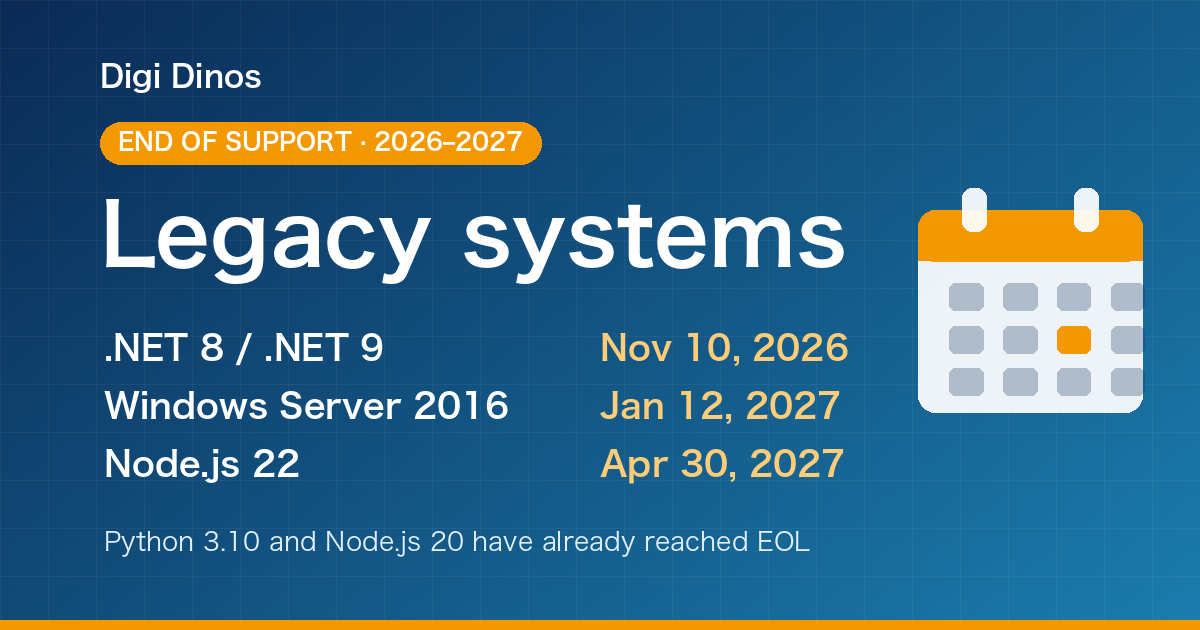
Securing Legacy Systems: Where to Start (2026 EOL Guide)

Superior Features of ChatGPT 4o (4 Omni)

What Is Digital Transformation? Definition, Roadmap and Examples

The Secret to Happiness!

What Is an IT Comtor? Role, Skills and How It Differs from a BrSE