

What Is Digital Transformation? Definition, Roadmap and Examples

Contents9
Digital transformation (DX) is the process of using digital technology and data to change how a business operates, makes decisions and serves its customers. It is not about buying more software; it is about redesigning processes and business models so that technology creates real value.
Key takeaways
- Digital transformation changes how a business works and creates value, not just where its documents are stored.
- It is the third of three stages: digitization → digitalization → digital transformation.
- Six pillars have to move together: people, processes, data, technology, customer experience and security.
- The safest way in: start with one small, measurable problem, prove it works, then scale.
What is digital transformation?
Digital transformation is an organisation-wide change built on digital technology: processes are redesigned, data becomes the basis for decisions, products and services reach customers through digital channels, and people work in new ways.
The easiest test is to look at the result: has technology only replaced a tool, or has it changed the way the work is done?
Not yet digital transformation
- Spreadsheets moved to the cloud, but still compiled by hand at month-end
- New software forced to copy the old paper process step by step
- One system per department, with data that never meets
Digital transformation
- Real-time sales data used to adjust stock and pricing
- The process is redesigned first, then the right software is chosen
- Customers order, pay and track deliveries in one digital channel
Digitization, digitalization and digital transformation
The three terms are often used interchangeably, but they are three stages, each building on the one before:
| Stage | What it means | Example |
|---|---|---|
| Digitization | Converting paper or analog information into digital form | Scanning paper contracts into PDFs |
| Digitalization | Running an existing process in software | Approving leave requests in a system instead of on paper |
| Digital transformation | Changing the business model, culture and the way value is created through technology and data | Selling online and personalising offers from purchase data |
Remember
Digitization and digitalization are the foundations; digital transformation is the goal. You do not have to finish one stage before starting the next, but without the foundations the third stage rarely holds.
Why businesses need it
In Japan, the cost of standing still has been measured. The Ministry of Economy, Trade and Industry (METI) warned in 2018 of a "2025 digital cliff", and the follow-up in 2025 found the problem far from solved:
¥12trillion
Possible economic loss per year from 2025 if ageing systems are left as they are (METI, 2018)
61%
Japanese user companies surveyed still running legacy systems in 2025 (METI, Digital Agency, IPA)
790,000
IT workers Japan could be short of by 2030, in METI's high-demand scenario
For an individual business, the reasons are concrete:
- Customers have moved to digital channels: they search, compare, order and pay on their phones and expect fast responses.
- Operational efficiency: automating repetitive work reduces errors, shortens lead times and frees people for higher-value work.
- Data-driven decisions: live dashboards instead of manual month-end reports.
- Less legacy risk: patched-together systems that few people understand get more expensive to run and harder to connect to anything new.
Vietnam's national programme
Vietnam made digital transformation a national goal with Decision 749/QĐ-TTg of 3 June 2020, built on three pillars (digital government, digital economy and digital society). It targets a digital economy worth 20% of GDP by 2025 and 30% by 2030.
The pillars of digital transformation
Digital transformation works when these six move forward together. Strong technology with weak people or data usually ends at "we have new software".
People and culture
Committed leadership and staff who are trained and ready to work differently.
Processes
Redesigned, rather than digitised exactly as they are.
Data
Collected correctly, kept in one place and owned by someone.
Technology
Cloud, web and mobile apps, system integration, and AI where the problem genuinely calls for it.
Customer experience
Every change should make buying easier, faster and more satisfying.
Security and governance
The more data is centralised, the more it needs access control, backups and clear rules.
A five-step roadmap
You do not need a multi-year master plan. This roadmap shows results early and keeps the risk small:
- Assess where you are
Which processes are manual, where the data lives, which systems are in use and who runs them.
- Set goals
A few measurable business goals, such as shorter order handling time or a higher repeat purchase rate.
- Pilot a small problem
One process with clear impact, delivered in months rather than a multi-year programme.
- Deploy and measure
Compare before and after, gather feedback from real users and adjust.
- Scale
Extend what worked to other departments and connect the systems together.
In step 2, tie each goal to a number you can track. Some examples:
| Problem | What to measure | How |
|---|---|---|
| Slow order handling | Time from order to delivery | Average before and after the new system |
| Hand-made reports | Hours spent on reports each month | Time logged by the people who prepare them |
| Few returning customers | Share of customers who buy a second time | Purchase data per customer |
| Data entry mistakes | Corrections needed each week | System logs or an error tracker |
Choosing the pilot
Pick a process that annoys many people, happens every day and is easy to measure. A visible result makes the whole company believe in the next step.
Examples by industry
E-commerce and retail
Online ordering with stock synchronised in real time between shops and warehouse.
Healthcare
Online booking and digital patient questionnaires that cut waiting time and paperwork.
Education
School-to-parent messaging in an app, with classes and homework managed on one platform.
Manufacturing
IoT sensors that monitor machines so they are serviced before they fail.
Finance
Opening an account online with electronic identity verification (eKYC).
Back office
Electronic approvals, digital signatures, attendance and HR in one system.
Common challenges
Most digital transformation projects do not fail because of the technology, but because of how they start. Two approaches side by side:
Likely to fail
- Starting from the latest technology instead of a business problem
- Data left scattered across inconsistent systems
- Everything handed to IT, with nobody from the business involved
- New ways of working imposed without training or support
Better approach
- Start from one specific problem with a number to improve
- Bring the data together in one place, with an owner
- Put business and technical people in the same team
- Train, listen to feedback and improve in short cycles
Success is not the norm
In McKinsey's 2018 survey, only 16% of respondents said their organisation's digital transformation had both improved performance and sustained the change over the long term. Small steps with measured results are the most reliable way to lower that risk.
Frequently asked questions
Do small businesses need digital transformation?
Yes, and they can often move faster, with fewer legacy systems and fewer layers of approval. Start with one concrete task, such as taking orders online or keeping customer records in one place.
How long does it take?
Digital transformation is ongoing and has no finish line, but a good pilot should show measurable results within a few months.
Do we have to use AI?
No. AI helps once you have clean data and a clear problem, such as forecasting demand or sorting support requests. Many businesses get large gains just from redesigning processes and connecting their systems.
Where should we start?
With an assessment: list the work still done by hand and where your data lives, then pick the most time-consuming problem as the pilot.
Digital transformation with Digi Dinos
Digi Dinos designs and builds web systems, mobile applications and integrations for companies in Japan and Vietnam, from the initial assessment through to running the system after launch. Read more about our services and our industry solutions.
Have a process you want to digitalise?
Tell us about it. We will work out together where to start and give you a cost estimate, free of charge.
Talk to us Our servicesSources
- METI, DX Report: overcoming the "2025 digital cliff" (summary, September 2018, Japanese)
- Digital Agency, on the Legacy System Modernisation Committee final report by METI, the Digital Agency and IPA (May 2025, Japanese)
- Government of Vietnam, Decision 749/QĐ-TTg on the National Digital Transformation Programme to 2025, with a vision to 2030 (Vietnamese)
- McKinsey & Company, Unlocking success in digital transformations (October 2018)
Related articles

PHP Vulnerability CVE-2026-109618 (PHP2shell): What to Do Now
PHP Upgrade Cost: Moving From PHP 5 or 7 to PHP 8
Taking Over a Legacy System With No Documentation

Node.js Security Release, October 2026: What to Do
Java Vulnerabilities, October 2026: IPA Alert and Licence Changes
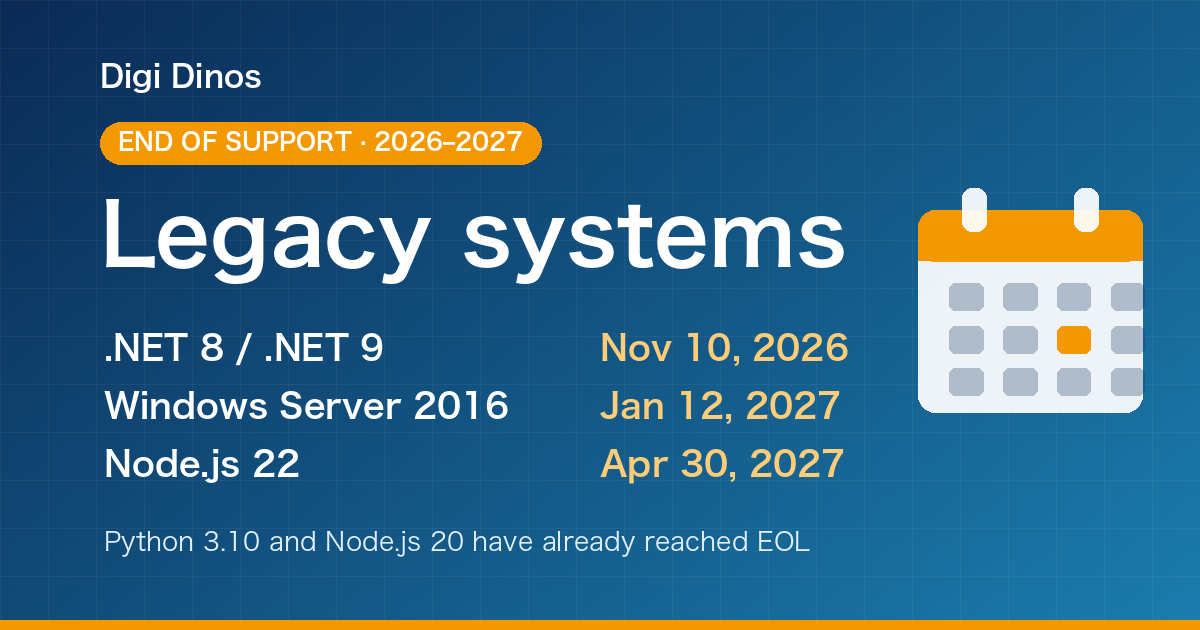
Securing Legacy Systems: Where to Start (2026 EOL Guide)
Superior Features of ChatGPT 4o (4 Omni)

The Secret to Happiness!

What Is an IT Comtor? Role, Skills and How It Differs from a BrSE