VMware vCenter CVE-2026-123890: Authentication Bypass
Contents9
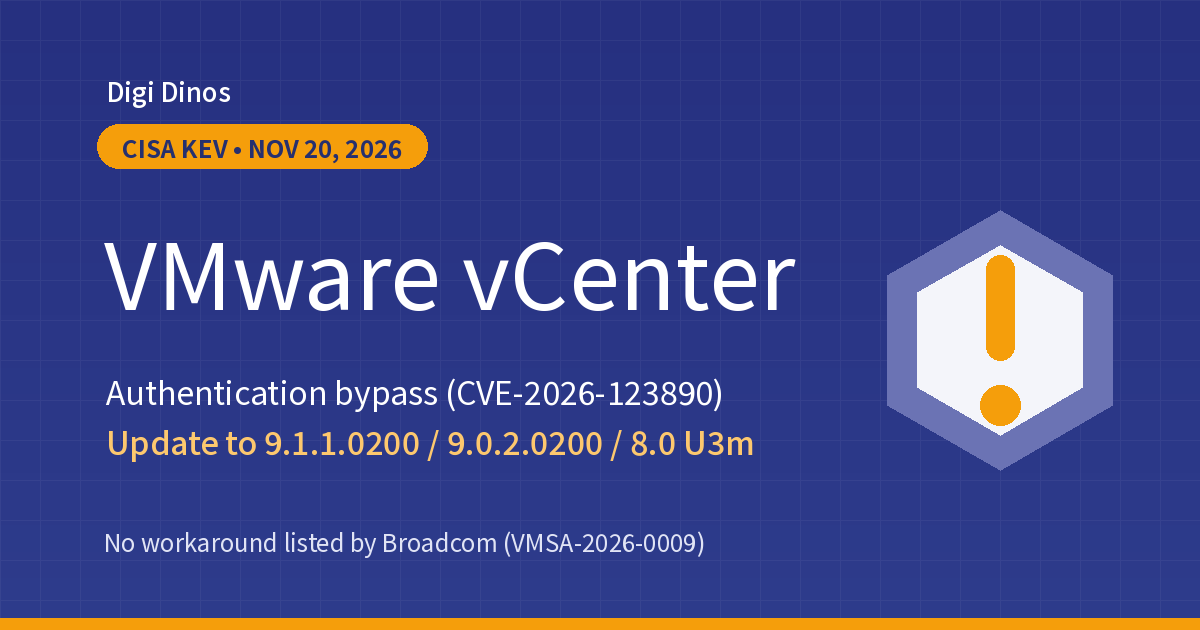
On 19 November 2026, Broadcom released fixed versions for CVE-2026-123890, a critical vulnerability in VMware vCenter (security advisory VMSA-2026-0009). An attacker who can reach vCenter over the network can bypass authentication and get into the management interface, and the severity (CVSS) is the maximum 9.8. On 20 November, the US CISA added this vulnerability to its Known Exploited Vulnerabilities (KEV) catalog.
This article is for companies that use VMware as their virtualization platform. It explains the affected versions, the fixed versions, points to know before updating, and checks to make after updating. vCenter is the "command center" for all of your virtual servers. Even if it is only visible from your internal network, please plan to update soon.
Key points of this article
- The affected product is vCenter. According to Broadcom's advisory, there is no workaround. Updating to a fixed version is the only remedy.
- The fixed versions are 9.1.1.0200 for 9.1, 9.0.2.0200 for 9.0, and 8.0 U3m for 8.0. For 7.0, you contact Broadcom if you have an extended support contract; there is no regular public fixed version.
- ESX (ESXi), NSX, VCF Operations and VCF Automation are stated to be not affected. This is also not a "VM escape" that breaks out of a virtual machine.
- The same advisory also covers vulnerabilities in SDDC Manager (3) and VMware Tools for Windows (1). If they apply to you, update them together.
9.8
Severity of CVE-2026-123890 (CVSS, Broadcom)
5
Number of vulnerabilities in VMSA-2026-0009
0
Number of workarounds given by Broadcom
Terms explained
vCenter = software that manages multiple VMware servers (ESX/ESXi) and virtual machines together. If an attacker gets in here, they could take control of the management of the entire platform.
Authentication bypass = a weakness that lets someone slip past checks such as ID and password and end up logged in.
VMware Directory Service = the component inside vCenter that manages user information. The weakness this time is here.
SDDC Manager = the component in VMware Cloud Foundation (VCF) that manages updates and configuration of the platform.
KEV = the list published by the US CISA of "vulnerabilities confirmed to be exploited in real attacks".
What happened, and why is it dangerous?
According to Broadcom's advisory (published 19 November 2026, updated 20 November), CVE-2026-123890 is an authentication bypass vulnerability in vCenter's "VMware Directory Service". It states that an attacker who can reach vCenter over the network can bypass authentication and gain unauthorized access to the system. Mandiant is listed as the reporter.
The CVSS vector describes an attack over the network that needs no special privileges and no user interaction, with a large impact on confidentiality, integrity and availability.
Exploitation status (as of 24 November 2026)
CISA added CVE-2026-123890 to the KEV catalog on 20 November and asked US federal agencies to respond by 23 November. It also asked them to carry out a "forensic check" to determine whether they had been compromised. Its use in ransomware attacks is listed as "unknown".
On the other hand, we could not find any mention of exploitation in Broadcom's advisory or Q&A. The official information we checked also contains no attack methods and no specific indicators of compromise (IoC) for investigating intrusions. We also found no entry covering this issue in IPA's list of alerts (checked 24 November).
Affected versions and fixed versions
| Product / version | Fixed version |
|---|---|
| vCenter 9.1 (VCF/VVF) | 9.1.1.0200 |
| vCenter 9.0 (VCF/VVF) | 9.0.2.0200 |
| vCenter 8.0 | 8.0 U3m |
| vCenter 7.0 | If you have an extended support contract, contact Broadcom |
| VMware Cloud Foundation 5.x | 5.2.5 (for vCenter, the async patch procedure, KB88287) |
| Telco Cloud Platform / Infrastructure | Procedure in KB463116 |
Note: General support for vSphere 7 ended on 2 October 2025. Broadcom's Q&A advises that older versions not listed in the advisory (6.5, 6.7 and so on) should also be "treated as affected". Updates are cumulative, so versions newer than those in the table also include the fix.
The other 4 issues in the same advisory
| CVE | Description | Severity | Fixed version |
|---|---|---|---|
| CVE-2026-123891 | SQL injection in SDDC Manager (targeting authenticated attackers) | 8.1 | 9.1.1.0200/9.0.2.0100/5.2.5 |
| CVE-2026-123892 | Command injection in SDDC Manager (authenticated) | 7.2 | Same as above |
| CVE-2026-123893 | Local privilege escalation in SDDC Manager (from administrator rights to root) | 6.7 | Same as above |
| CVE-2026-123894 | SAML token signature bypass in VMware Tools for Windows (privilege escalation inside a Windows virtual machine with a guest alias configuration) | 6.7 | 13.1.5.0 (13.x)/12.5.5 (12.x) |
The VMware Tools issue lets an attacker who already has access to a privileged process inside a Windows virtual machine raise their privileges. Broadcom explains that it is not a vulnerability that lets an attacker go from a virtual machine to the platform (ESX).
3 points to know before updating
- The "Back-in-Time" restriction
If you install vCenter 8.0 U3m or 9.0.2.0200, you temporarily cannot upgrade to VCF 9.1.1. Broadcom advises waiting for 9.1.2. If you are partway through an upgrade, decide whether to "wait" or to "first move vCenter to 9.1.1 and then apply the fix".
- Quick Patch cannot be used
This vCenter update is not covered by the "vCenter Quick Patch" introduced in VCF 9.1. Use the normal update procedure.
- Virtual machines do not stop
While vCenter is being updated, management screens such as the vSphere Client are unavailable for a short time, but running virtual machines and containers keep running. New operations related to encryption (such as key rotation) cannot be used while vCenter is down.
5 steps to check and respond
- List your vCenter instances and versions
Check the build number on the Summary tab of the vSphere Client, or with PowerCLI. Do not forget subsidiaries' and test vCenter instances.
- Check where it can be reached from
Check where the vCenter management interface can be reached from, and limit it to the management network. This is a general measure and not a workaround given by Broadcom. It is also not a substitute for updating.
- Plan the update
Plan the fixed versions in the table above as an emergency change. Broadcom's Q&A also says this counts as an emergency change under ITIL thinking. Updating ESX is not required. Check compatibility in the VMware Product Interoperability Matrix.
- Update SDDC Manager and VMware Tools as well
If you use SDDC Manager, update to 9.1.1.0200/9.0.2.0100/5.2.5. For Windows virtual machines, update VMware Tools to 13.1.5.0 or 12.5.5 or later.
- Check for signs of intrusion
Look in vCenter's login records for operations you do not recognize or administrators that were added. Because no official investigation method has been published, it is safest to consult a specialist company whether or not you find anything.
How to check your vCenter version
- The build is shown on the Summary tab of the vSphere Client
- With PowerCLI, after connecting with
Connect-VIServer, you can check with$global:DefaultVIServer.Versionand.Build(Broadcom's Q&A) - The VMware Tools version on a Windows virtual machine can be checked on each virtual machine's Summary tab
For checking other "entry point" devices such as VPN appliances and firewalls, please also refer to "Check Point vulnerability: PHP2Shell exploited and fixed versions" and "Ivanti vulnerability: updating VPN appliances and investigating intrusions".
What if you leave it? What if you act?
If you leave it as it is
- Authentication could be bypassed and control of the virtual platform's management could be taken
- The impact could spread across the whole platform, such as virtual machines being stopped, deleted or cloned
- There is no workaround, so the same state continues until you update
If you update and check
- The vCenter authentication bypass is fixed
- The SDDC Manager and VMware Tools vulnerabilities are fixed at the same time
- You can review where the management interface can be reached from
Leave it to Digi Dinos
Digi Dinos is a company that supports DX, security, and system operations and maintenance. We hold ISO 27001 certification, and we also handle server and cloud operations and 24/7 monitoring (NOC). Even for work on systems that are hard to stop, such as updating a virtualization platform, we proceed with a fixed procedure and schedule.
- Asset inventory: We sort out which versions of vCenter, ESX and SDDC Manager are running, and who manages them.
- Update planning and implementation support: We set up the update steps, taking into account compatibility, the Back-in-Time restriction and the work window.
- Operations handover: We can also take over the operation of a virtualization platform that another company managed.
Even just a question like "Is our vCenter OK?" is welcome (free consultation)
From checking versions to planning the update, we will guide you in Japanese.
Frequently asked questions
Do I need to update a vCenter that is not exposed to the internet?
Yes. Broadcom's advisory assumes "an attacker who can reach vCenter over the network". If an attacker gets into your internal network, or if the separation of your management network is weak, it could be exploited.
Am I safe if I do not use Enhanced Linked Mode?
No. According to Broadcom's Q&A, this issue is in vCenter itself and exists regardless of whether Enhanced Linked Mode is used.
Do I need to update ESX as well?
No. According to Broadcom's Q&A, ESX is not covered by this advisory. However, please check in the VMware Product Interoperability Matrix whether the updated vCenter supports the ESX version you use.
I use vSphere 7. What should I do?
General support for vSphere 7 ended on 2 October 2025. If you have an extended support contract, ask Broadcom support for the fix. If you do not, plan a move to VCF 9.1 or similar, which Broadcom recommends. Until you update, strengthen general measures such as narrowing down the management network.
References and sources (checked 24 November 2026)
- Broadcom, "VMSA-2026-0009: VMware vCenter, Tools, and SDDC Manager updates address multiple vulnerabilities" (published 19 November 2026, updated 20 November)
- Broadcom, "VMSA-2026-0009: Questions & Answers"
- CISA, "Known Exploited Vulnerabilities Catalog: CVE-2026-123890" (added 20 November 2026)
- IPA, "Important security information (fiscal year 2026)"
Related articles

What Is GEO? Getting Recommended by AI Search and AI Agents
PHP Vulnerabilities, November 2026: 7 Critical Flaws and Fixes
GitLab Vulnerabilities, November 2026: Update to 19.6.1
Java4Shell (CVE-2026-114938): Who Is Affected and How to Fix It
NGINX Vulnerabilities: HTTP/2 RCE and Version 1.30.7
Check Point CVE-2026-123039: Exploited with PHP2Shell
Microsoft 365 Outage, November 2026: Cause and Recovery
Microsoft November 2026 Updates: Exploited Outlook Flaw and KBs
OpenSSH CVE-2026-123158: Alpine Login Bypass and What to Do
Japan Data Breaches, Early November 2026: A Summary
Arara Message Breach Update: About 81 Million Email Addresses
SonicWall SSLVPN CVE-2026-19868: MFA Bypass and What to Do
Apache Tomcat Vulnerabilities, October 2026: 8 Flaws and Fixes
.NET 8 and 9 End of Support on 10 November 2026: What to Do
Movable Type Vulnerability JVN#91153973: Update or Mitigate Now
WordPress CVE-2026-119977: Listed as Exploited, Update Now
Japan Data Breaches, Oct–Nov 2026: What Companies Should Check
Ivanti Connect Secure Zero-Days: Update Again and Investigate
GitLab CVE-2026-97229 (CVSS 10): Exploited, Patch Now
Linux Kernel Fragnesia (CVE-2026-46300): Exploited, Patch Now
Brotli Vulnerability CVE-2026-111497 (HTTP2Shell): What to Do
PHP Vulnerability CVE-2026-109618 (PHP2shell): What to Do Now
PHP Upgrade Cost: Moving From PHP 5 or 7 to PHP 8
Taking Over a Legacy System With No Documentation
Node.js Security Release, October 2026: What to Do
Java Vulnerabilities, November 2026: Versions to Install
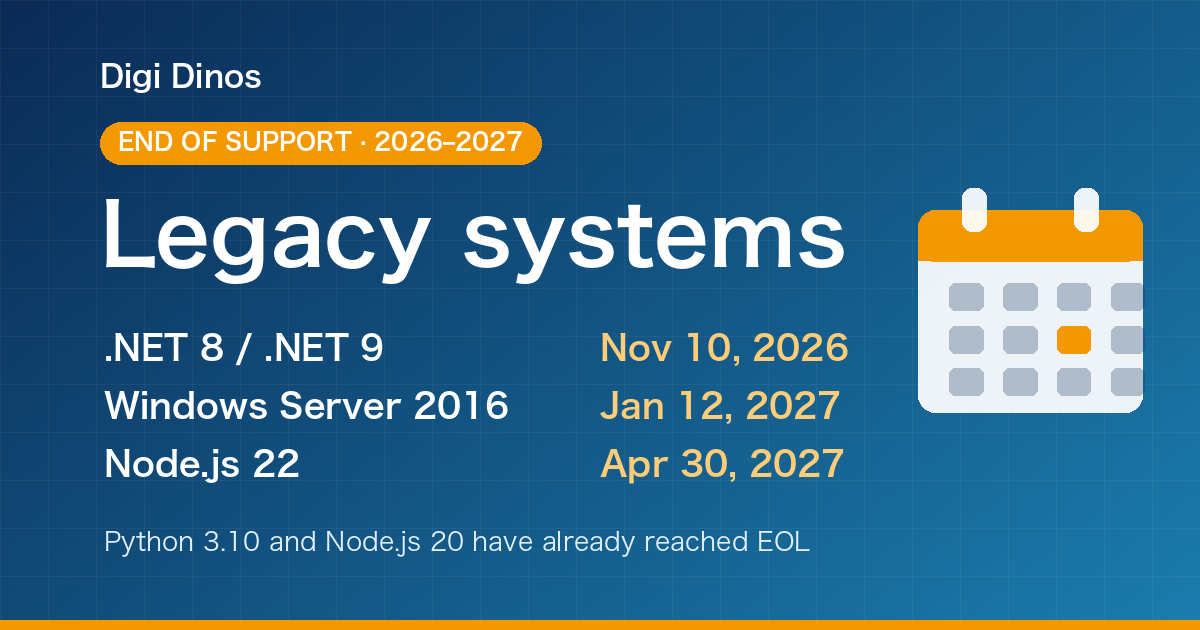
Securing Legacy Systems: Where to Start (2026 EOL Guide)
Superior Features of ChatGPT 4o (4 Omni)

What Is Digital Transformation? Definition, Roadmap and Examples

The Secret to Happiness!

What Is an IT Comtor? Role, Skills and How It Differs from a BrSE