Apache Tomcat Vulnerabilities, October 2026: 8 Flaws and Fixes
Contents9
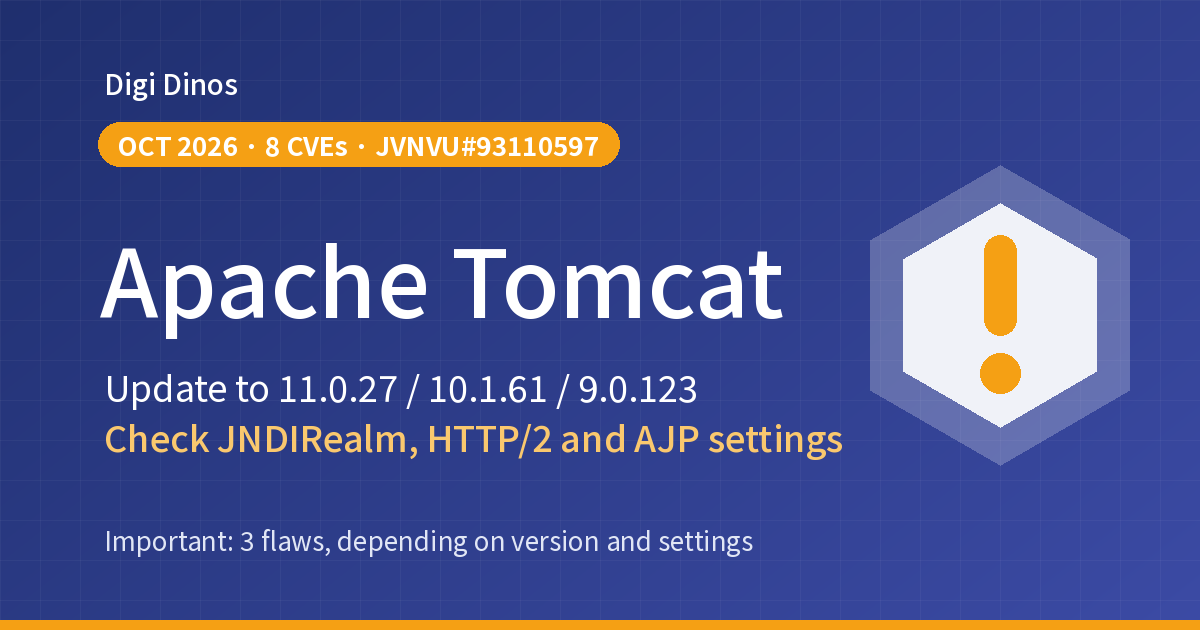
On 20 October 2026, eight vulnerabilities were published in Apache Tomcat, software that runs web applications. The next day, the 21st, JVN also covered them as "JVNVU#93110597". The fixed versions are 11.0.27, 10.1.61 and 9.0.123.
This article is for companies with business systems built in Java. It explains which versions are affected, how the impact changes depending on your configuration, and how to update. Tomcat is often built into packaged products and Spring Boot applications, so even companies that think "we don't use it" should check.
Key takeaways
- Of the eight, three are rated "Important" by Apache. They are a loophole in LDAP authentication, and problems that may cause another person's response to get mixed in over HTTP/2 or AJP.
- These three apply only with certain configurations or versions. It is important to check your own configuration.
- The response is to update to 11.0.27, 10.1.61, 9.0.123 or later.
- Some of the issues also affect versions that are no longer supported, such as 8.5 and 7.0. No fixed versions will be provided for them.
8
Vulnerabilities published (3 Important, 5 Low)
9.1
Highest CVSS assigned by CISA (2 issues)
12 October
Release date of the fixed versions (the vulnerabilities were published on the 20th)
Terms used here
Tomcat = software for running web applications built in Java. It is widely used in business systems.
Vulnerability = a weak spot in a system. If an attacker finds it, the system may be attacked through it.
LDAP = a communication method often used by systems that manage employee IDs and passwords in one place.
HTTP/2 and AJP = communication methods for exchanging data with web servers and browsers.
What are the vulnerabilities, and which should you deal with first?
The three more serious issues are as follows. None of them occurs on every Tomcat; the impact depends on the version and configuration.
| CVE ID | What could happen | Conditions |
|---|---|---|
| CVE-2026-101296 Important | A user can log in even without the correct password | When JNDIRealm (authentication linked to LDAP and similar systems) is set up with SASL authentication other than GSSAPI |
| CVE-2026-101356 Important | After an error in HTTP/2 asynchronous processing, requests or responses may get swapped with those of another user | When HTTP/2 is used and there is a servlet that uses asynchronous processing. 11.0.22–26, 10.1.55–60, 9.0.118–122 |
| CVE-2026-103119 Important | A large AJP response may spill over into the next request, and data from the previous response may leak to the next person | Only the 11.0 branch when AJP is used (11.0.0-M25 to 11.0.26) |
In the server.xml bundled with Tomcat, the AJP connector and the HTTP/2 settings are commented out. In other words, with the default settings, the AJP and HTTP/2 problems do not come into play. However, quite a few companies have changed these settings and use them. Don't decide "not affected" without looking at your own configuration.
The remaining five are rated "Low" by Apache.
- CVE-2026-93446: TLS 1.3 connections can sometimes fail
- CVE-2026-88041: HTTP/2 trailer information gets mixed into the next request
- CVE-2026-74049: After
<c:redirect>in a JSP, the rest of the page continues to be processed - CVE-2026-74048: Even if enabling FIPS mode fails, Tomcat still starts up
- CVE-2026-80353: An issue with permission settings for UNIX domain sockets (listed under the 9.0 branch)
Exploitation could not be confirmed. However, the ratings differ
Apache's notices and JVN make no mention of actual attacks. The eight issues were also not found on the US CISA list of "known exploited vulnerabilities" (as published on 6 November 2026).
On the other hand, in the CVE records, CISA has given CVE-2026-101356 and CVE-2026-103119 a CVSS score of 9.1. That is higher than Apache's "Important" rating. If the configuration applies to you, give these priority.
Note that a separate Tomcat vulnerability (CVE-2026-34486) was added to the CISA list in August 2026. It is important to have a system for applying fixes soon after they come out.
Affected versions and where to move
| Branch | Version to update to | Java you can use | Notes |
|---|---|---|---|
| 11.0 | 11.0.27 or later | 17 or later | 7 of the 8 issues apply |
| 10.1 | 10.1.61 or later | 11 or later | 6 of the 8 issues apply |
| 9.0 | 9.0.123 or later | 8 or later | End of support is not expected to be earlier than 31 March 2027 (Apache's guidance) |
| 8.5, 7.0 and others | No fix | ― | Affected by CVE-2026-101296 and others. Move to a supported version |
※ Support for the 8.5 branch ended on 31 March 2024. According to the CVE records, CVE-2026-101296 and CVE-2026-74049 also affect the 8.5 and 7.0 branches.
※ If you are on the 9.0 branch, it will be easier to plan your next steps if you also check Apache's plans for the 9.1 branch.
Five steps to check and respond
- Find out where Tomcat is running
As well as copies installed directly on servers, check those built into packaged products, Docker images and Spring Boot applications (
tomcat-embed-core). - Check the version
On a server, you can check with
bin/version.sh(version.baton Windows). If it is built into an application, look at the dependencies at build time. - Check the configuration
In
server.xmland similar files, check whether the JNDIRealm authentication method, HTTP/2 (UpgradeProtocol) or an AJP connector is in use. - Try the update in a test environment
An update within the same branch has a relatively small impact. Try the main functions, such as login, file upload and connections with outside systems, before applying it to production.
- Check the Java version too
While updating Tomcat, review your Java version as well. See also "Java Vulnerabilities, October 2026".
If you can't update right away
Apache's notices give updating to the fixed version as the response. Until you update, you can reduce the risk by stopping the affected functions. To fix the problem properly, you need to update.
- If you don't use AJP, disable the connector. If you do use it, make sure it cannot be reached from outside
- If you don't need HTTP/2, remove the
UpgradeProtocolsetting - If the LDAP integration settings apply to you, set a date for the update as a priority
For companies with old Java systems
Systems with an outdated Tomcat often have an outdated Java and OS too. If you can't update everything at once, review the parts exposed to the internet first. The approach is explained in "Securing Legacy Systems: Where to Start", and if you can't reach your development company, see "Taking Over a Legacy System With No Documentation".
Questions for your contractors
- What version of Tomcat is our system on now? Have the fixes published in October been applied?
- Is a separate copy of Tomcat built into any of the applications or packages?
- Do we use LDAP integration, HTTP/2 or AJP?
- Are Tomcat updates included in the maintenance contract?
Leave it, or act now?
If you leave it
- Depending on the LDAP integration settings, login by impersonation may be possible
- Another user may be able to see the content of responses
- Fixes pile up and the next update becomes harder
If you update to the fixed version
- All eight issues are fixed together
- You are on a supported version and can receive future fixes
- You can tell business partners it has been dealt with
How Digi Dinos can help
Digi Dinos is a company that supports DX, security, and the operation and maintenance of systems. We have offices in Japan and Vietnam, and over the 8 years since our founding we have delivered more than 150 projects. We are ISO 27001 certified, and our team works in Japanese.
- Java and Tomcat updates: from checking versions and configuration to testing and applying the update to production.
- Taking over maintenance of old systems: we also read and investigate the code of systems built by other companies, and take them over.
- Migration planning: we propose how to move from an unsupported version, together with the cost and timeline.
- Lifetime warranty: if a defect turns up in work we did, we take responsibility and fix it, with no time limit for as long as the maintenance contract continues.
Is your Tomcat safe? Even a simple question is welcome (free consultation).
From how to check your versions and configuration to planning the update, with guidance in Japanese.
Frequently asked questions
We don't use LDAP integration. Do we still need to update?
Yes. The update also covers issues other than the Important ones, and staying on an old version makes the next update more of a burden. Even if it is less urgent, plan the update.
Ours is a Spring Boot application. Where should we check?
Check the version of tomcat-embed-core in your build dependencies. Either raise the Spring Boot version, or update by specifying the Tomcat version.
We are using Tomcat 8.5. What should we do?
Support for the 8.5 branch ended in March 2024, and there is no fixed version this time. Plan a move to the 9.0 branch or later. Until then, keep what is exposed to the outside as limited as possible.
How long is the 9.0 branch supported?
Apache says that the end of support for the 9.0 branch will not be earlier than 31 March 2027. After that, the 9.1 branch is planned to be available. Check the latest guidance.
Sources (checked on 8 November 2026)
- JVN, "JVNVU#93110597: Apache Tomcatにおける複数の脆弱性" (20 October 2026)
- Apache Tomcat, "Apache Tomcat 11.x vulnerabilities"
- Apache Tomcat, "Apache Tomcat 10.x vulnerabilities"
- Apache Tomcat, "Apache Tomcat 9.x vulnerabilities"
- Apache Tomcat, "Which Version Do I Want?" (support status)
- CVE Record, "CVE-2026-101296"
- CVE Record, "CVE-2026-101356"
- CVE Record, "CVE-2026-103119"
- CISA, "Known Exploited Vulnerabilities Catalog" (as published on 6 November 2026)
Related articles
Japan Data Breaches, Early November 2026: A Summary
Arara Message Breach Update: About 81 Million Email Addresses
SonicWall SSLVPN CVE-2026-19868: MFA Bypass and What to Do
.NET 8 and 9 End of Support on 10 November 2026: What to Do
Movable Type Vulnerability JVN#91153973: Update or Mitigate Now
WordPress CVE-2026-119977: Listed as Exploited, Update Now
Japan Data Breaches, Oct–Nov 2026: What Companies Should Check
Ivanti Connect Secure Zero-Days: Update Again and Investigate
GitLab CVE-2026-97229 (CVSS 10): Exploited, Patch Now
Linux Kernel Fragnesia (CVE-2026-46300): Exploited, Patch Now
Brotli Vulnerability CVE-2026-111497 (HTTP2Shell): What to Do
PHP Vulnerability CVE-2026-109618 (PHP2shell): What to Do Now
PHP Upgrade Cost: Moving From PHP 5 or 7 to PHP 8
Taking Over a Legacy System With No Documentation
Node.js Security Release, October 2026: What to Do
Java Vulnerabilities, October 2026: IPA Alert and Licence Changes
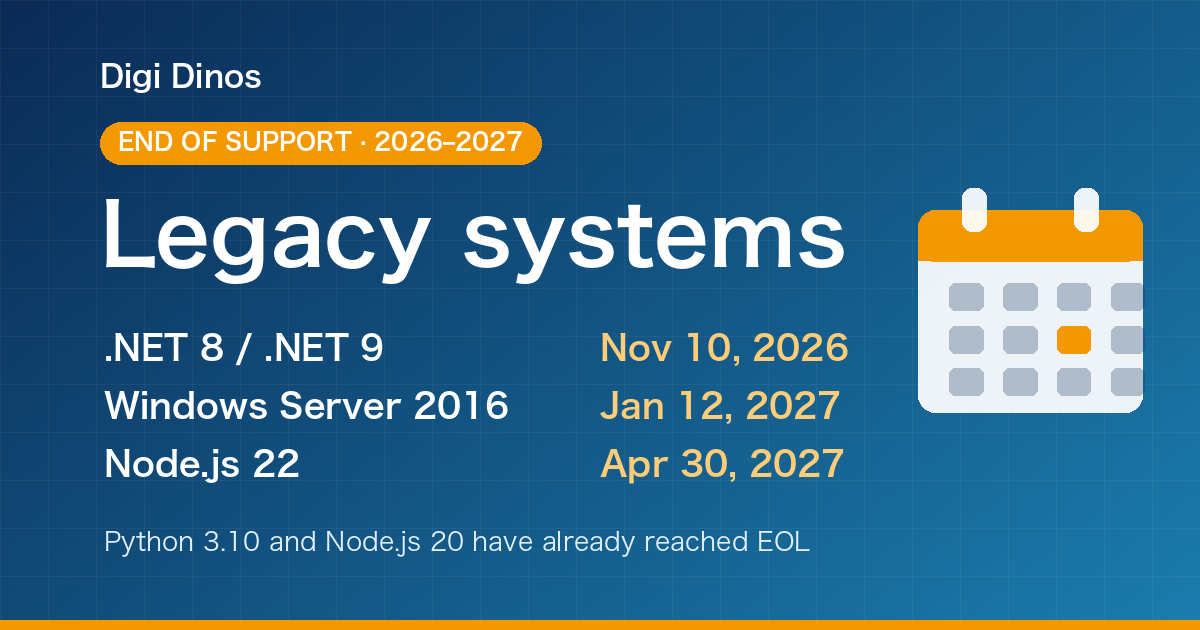
Securing Legacy Systems: Where to Start (2026 EOL Guide)
Superior Features of ChatGPT 4o (4 Omni)

What Is Digital Transformation? Definition, Roadmap and Examples

The Secret to Happiness!

What Is an IT Comtor? Role, Skills and How It Differs from a BrSE