Apache Tomcat Vulnerabilities, November 2026: 11 Flaws and Fixes
Contents8
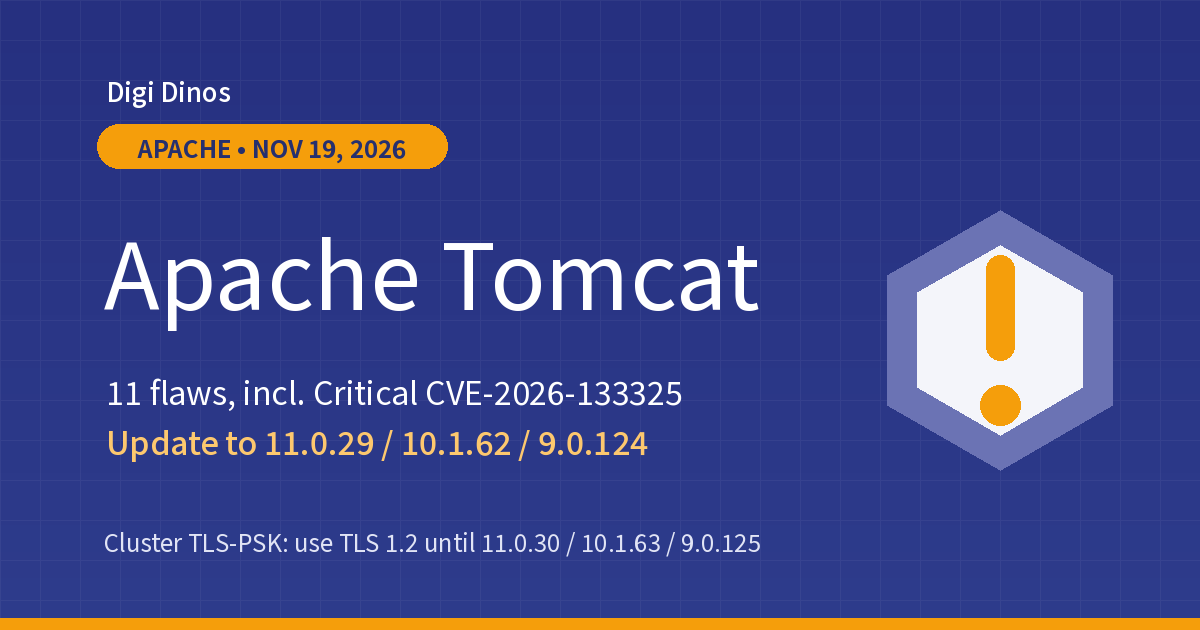
On 19 November 2026, Apache published 11 vulnerabilities in Apache Tomcat. Ten of them are fixed in 11.0.29, 10.1.62 and 9.0.124, released on 13 and 16 November. However, the remaining one (CVE-2026-133325, severity Critical) is a problem in those new versions themselves, and the versions that fix it (11.0.30, 10.1.63, 9.0.125) had not yet been released as of 26 November. JVN also covered the issues on 25 November as "JVNVU#92527429".
This article follows on from "Apache Tomcat Vulnerabilities, October 2026: 8 Flaws and Fixes", which explained the eight issues published in October. The October fixed versions (11.0.27, 10.1.61, 9.0.123) are also affected this time, so you need to update once more. This article explains which versions are affected, how the impact changes depending on your configuration, and what to do for now about the Critical issue.
Key takeaways
- Update to 11.0.29, 10.1.62 or 9.0.124. If you stay on the October fixed versions, the 10 issues published this time remain.
- The Critical CVE-2026-133325 is a problem only when cluster communication (several Tomcat servers working together) is protected with TLS 1.3 and TLS-PSK. The affected versions are 11.0.28 to 11.0.29, 10.1.62 and 9.0.124.
- As a measure until the fixed versions come out, Apache advises switching cluster encryption to TLS 1.2 (TLS-PSK).
- If you use EncryptInterceptor to encrypt your cluster, its own weaknesses (CVE-2026-95517) will not be fixed, and the feature has been deprecated. You need to switch to TLS.
11
Vulnerabilities published on 19 November (1 Critical, 4 Important, 2 Moderate, 4 Low)
9.8
CVSS score CISA gave CVE-2026-133325
Not yet released
11.0.30, 10.1.63 and 9.0.125, which fix the Critical issue (as of 26 November)
Terms used here
Tomcat = software for running web applications built in Java. It is widely used in business systems.
Cluster = a setup that connects several Tomcat servers so they can share things such as login status (sessions). It is used to build systems that do not stop.
TLS-PSK = a method that uses a shared key agreed in advance (something like a password) to confirm who you are communicating with and to encrypt the communication.
DoS = an attack that stops a service by overloading a server or making it use up its memory.
The Critical issue: a problem in the new versions
According to Apache's notice, CVE-2026-133325 is a problem where, when cluster communication is protected with TLS 1.3 and TLS-PSK, an unauthenticated node (another server) can join the cluster. It was reported on 16 November and published on the 19th.
Only 11.0.28 to 11.0.29, 10.1.62 and 9.0.124 are affected; versions from October and earlier are not included. Apache advises the following two measures.
- Switch cluster encryption to TLS 1.2 (TLS-PSK)
- Update once the fixed versions (11.0.30, 10.1.63, 9.0.125) are released
In the server.xml bundled with Tomcat, the cluster settings (Cluster) are commented out. If you are running a single server with the default settings, this issue does not apply to you. However, quite a few companies set up clusters for redundancy. Don't decide "not affected" without looking at your configuration.
Exploitation status (as of 26 November 2026)
Apache's notice and JVN make no mention of actual attacks. We also did not find any of the 11 issues on the US CISA list of "known exploited vulnerabilities" (KEV) (as published on 25 November 2026). In the assessments CISA added to the CVE records (10 of the issues have one), all are marked "no exploitation confirmed (none)".
On the other hand, CISA has given a CVSS score of 9.8 to CVE-2026-133325 and 9.1 to CVE-2026-95517, CVE-2026-116561 and CVE-2026-118028. These are higher than Apache's ratings. If the configuration applies to you, give these priority. We did not find any alert covering this issue in the lists of alerts from IPA and JPCERT/CC (checked 26 November).
If you use EncryptInterceptor
EncryptInterceptor is an older component for encrypting cluster communication. Apache published several weaknesses (CVE-2026-95517, Moderate), such as the lack of a way to check for tampering, and rather than fixing them, marked it "deprecated". Apache advises moving instead to TLS encryption with TLS-PSK.
However, TLS-PSK, the option you would move to, has the Critical problem described above. For that reason, Apache advises either using it with TLS 1.2 only on 11.0.29, 10.1.62 and 9.0.124, or waiting for the next versions (11.0.30, 10.1.63, 9.0.125).
The other 10 issues: which should you deal with first?
The four issues rated "Important" by Apache are as follows. For each of them, the impact depends on the version and the features you use.
| CVE ID | What could happen | Conditions |
|---|---|---|
| CVE-2026-118028 | Even when a RewriteValve [F], [G] or [R] rule matches, processing does not stop, and it continues after the request is refused or redirected | When RewriteValve is used to rewrite or refuse URLs. 11.0.0-M18 to 11.0.27, 10.1.20 to 10.1.61, 9.0.87 to 9.0.123 |
| CVE-2026-121649 | ExpiresFilter removes the "Cache-Control: private" header added by the authentication mechanism, so pages meant for one person may remain in a cache | When ExpiresFilter is used |
| CVE-2026-116830 | Resources are not released when handling HTTP/2 connections, and the service may stop (DoS) | When HTTP/2 is used |
| CVE-2026-116600 | Memory is not released in the integration between WebSocket and OpenWebBeans (OWB), and the service may stop (DoS) | When the OWB module and WebSocket are used |
In the settings bundled with Tomcat, HTTP/2 (UpgradeProtocol) and CGIServlet are commented out, and RewriteValve and ExpiresFilter are not included. With the default settings, these problems do not come into play. However, they may be used in your application settings (web.xml) or inside packaged products.
The rest are one "Moderate" issue and four "Low" issues.
- CVE-2026-118436 (Moderate): CGIServlet does not handle the body of a POST request correctly, and processing stays stuck (DoS)
- CVE-2026-106012 (Low): when a request is forwarded with RequestDispatcher.forward(), the permission check (security-role-ref) is done incorrectly
- CVE-2026-116561 (Low): even when Jakarta Authentication (JASPIC on the 9.0 branch) fails with an error, an unprotected "200" response is returned
- CVE-2026-117517 (Low): the fix for an earlier vulnerability (CVE-2026-25854) was incomplete
- CVE-2026-118233 (Low): memory is not released during HTTP upgrades, and the service may stop (DoS)
Affected versions and where to move
| Branch | Version to update to | Critical (CVE-2026-133325) | Notes |
|---|---|---|---|
| 11.0 | 11.0.29 (13 November) | To be fixed in 11.0.30 (not yet released) | Java 17 or later |
| 10.1 | 10.1.62 (16 November) | To be fixed in 10.1.63 (not yet released) | Java 11 or later |
| 9.0 | 9.0.124 (13 November) | To be fixed in 9.0.125 (not yet released) | Java 8 or later. End of support is not expected to be earlier than 31 March 2027 (Apache's guidance) |
| 8.5, 7.0 and others | No fix | ― | Move to a supported version |
※ Release dates are taken from Apache's vulnerability lists. We did not find 11.0.28 in either the lists or the download archive; on the 11.0 branch, the version after 11.0.27 is 11.0.29.
※ Support for the 8.5 branch ended on 31 March 2024. According to the CVE records, 8 of the 11 issues this time also affect the 8.5 branch. Some records also include the 7.0 branch.
Five steps to check and respond
- Find out where Tomcat is running
As well as copies installed directly on servers, check those built into packaged products, Docker images and Spring Boot applications (tomcat-embed-core).
- Check the version
On a server, you can check with bin/version.sh (version.bat on Windows). If it is built into an application, look at the dependencies at build time.
- Check the cluster settings
Check whether server.xml has an active Cluster setting, whether EncryptInterceptor or TLS-PSK is used to encrypt the communication, and which TLS version is used. If you are moving to 11.0.29 or similar, make sure it runs on TLS 1.2.
- Check the settings of other features
Check whether you use RewriteValve, ExpiresFilter, HTTP/2, CGIServlet or WebSocket, and schedule the update, starting with whatever applies to you.
- Try the update in a test environment, and prepare for the next version
Try the main functions, such as login, file upload and connections with outside systems, before applying it to production. If you use a cluster, also plan to update again when 11.0.30 and the others come out. Check your Java version too, in "Java vulnerability countermeasures".
Leave it, or act now?
If you leave it
- Redirect and refusal rules may not work, and processing you want to keep hidden may run
- Pages meant for one person may remain in a cache and be visible to others
- The service may be stopped by DoS
- A server pretending to be one of yours may join the cluster (with TLS 1.3 and TLS-PSK)
If you update and review the settings
- The problems published in October and November are fixed together
- You can keep using cluster encryption in a safe way
- You can tell business partners it has been dealt with
How Digi Dinos can help
Digi Dinos is a company that supports DX, security, and the operation and maintenance of systems. We are ISO 27001 certified, and we also handle server and cloud operations and monitoring 24 hours a day, 365 days a year (NOC). We also update Java business systems and take over systems built by other companies.
- Checking the current situation: we check the Tomcat version, settings such as clusters and RewriteValve, and whether Tomcat is built into your applications.
- Support for carrying out the update: from testing in a test environment to applying it to production, we proceed with a set procedure and schedule. We also include the second update after 11.0.30 and the others are released in the plan.
- Taking over operations: we can also take over the operation of systems where you cannot reach the development company and there is no one to update them.
Is your Tomcat safe? Even a simple question is welcome (free consultation).
We can help with everything from checking versions and configuration to planning the update.
Frequently asked questions
We only just updated to 11.0.27 in October. Do we need to update again?
Yes. The 10 issues this time also affect 11.0.27, 10.1.61 and 9.0.123. Please update to 11.0.29, 10.1.62 or 9.0.124.
We heard 11.0.29 has a Critical problem. Is it better not to update?
No. The Critical issue is a problem only when cluster communication is protected with TLS 1.3 and TLS-PSK. If you don't use a cluster, it does not apply to you. Even if you do, switching to TLS 1.2 follows Apache's guidance. If you stay on an old version, the other 10 issues remain unfixed.
Ours is a Spring Boot application. Where should we check?
Check the version of tomcat-embed-core in your build dependencies. Either raise the Spring Boot version, or update by specifying the Tomcat version.
We are using Tomcat 8.5. What should we do?
Support for the 8.5 branch ended in March 2024, and there is no fixed version this time. According to the CVE records, 8 of the 11 issues also affect the 8.5 branch. Plan a move to the 9.0 branch or later. Until then, keep what is exposed to the outside as limited as possible.
Sources (checked 26 November 2026)
- JVN, "JVNVU#92527429: Apache Tomcatにおける複数の脆弱性" (19 November 2026)
- Apache Tomcat, "Apache Tomcat 11.x vulnerabilities"
- Apache Tomcat, "Apache Tomcat 10.x vulnerabilities"
- Apache Tomcat, "Apache Tomcat 9.x vulnerabilities"
- Apache Tomcat, "[SECURITY] CVE-2026-133325", "[SECURITY] CVE-2026-95517" and others (announce mailing list, 19 November 2026)
- Apache Tomcat, "Which Version Do I Want?" (support status)
- CVE Record, "CVE-2026-133325" (see also the records for CVE-2026-95517, CVE-2026-116561 and CVE-2026-118028)
- CISA, "Known Exploited Vulnerabilities Catalog" (as published on 25 November 2026)
Related articles
Drupal CVE-2026-132165: Installer RCE Exploited
VMware vCenter CVE-2026-123890: Authentication Bypass

What Is GEO? Getting Recommended by AI Search and AI Agents
PHP Vulnerabilities, November 2026: 7 Critical Flaws and Fixes
GitLab Vulnerabilities, November 2026: Update to 19.6.1
Java4Shell (CVE-2026-114938): Who Is Affected and How to Fix It
NGINX Vulnerabilities: HTTP/2 RCE and Version 1.30.7
Check Point CVE-2026-123039: Exploited with PHP2Shell
Microsoft 365 Outage, November 2026: Cause and Recovery
Microsoft November 2026 Updates: Exploited Outlook Flaw and KBs
OpenSSH CVE-2026-123158: Alpine Login Bypass and What to Do
Japan Data Breaches, Early November 2026: A Summary
Arara Message Breach Update: About 81 Million Email Addresses
SonicWall SSLVPN CVE-2026-19868: MFA Bypass and What to Do
Apache Tomcat Vulnerabilities, October 2026: 8 Flaws and Fixes
.NET 8 and 9 End of Support on 10 November 2026: What to Do
Movable Type Vulnerability JVN#91153973: Update or Mitigate Now
WordPress CVE-2026-119977: Listed as Exploited, Update Now
Japan Data Breaches, Oct–Nov 2026: What Companies Should Check
Ivanti Connect Secure Zero-Days: Update Again and Investigate
GitLab CVE-2026-97229 (CVSS 10): Exploited, Patch Now
Linux Kernel Fragnesia (CVE-2026-46300): Exploited, Patch Now
Brotli Vulnerability CVE-2026-111497 (HTTP2Shell): What to Do
PHP Vulnerability CVE-2026-109618 (PHP2shell): What to Do Now
PHP Upgrade Cost: Moving From PHP 5 or 7 to PHP 8
Taking Over a Legacy System With No Documentation
Node.js Security Release, October 2026: What to Do
Java Vulnerabilities, November 2026: Versions to Install
Securing Legacy Systems: Where to Start (2026 EOL Guide)
Superior Features of ChatGPT 4o (4 Omni)

What Is Digital Transformation? Definition, Roadmap and Examples

The Secret to Happiness!

What Is an IT Comtor? Role, Skills and How It Differs from a BrSE