Drupal CVE-2026-132165: Installer RCE Exploited
Contents8
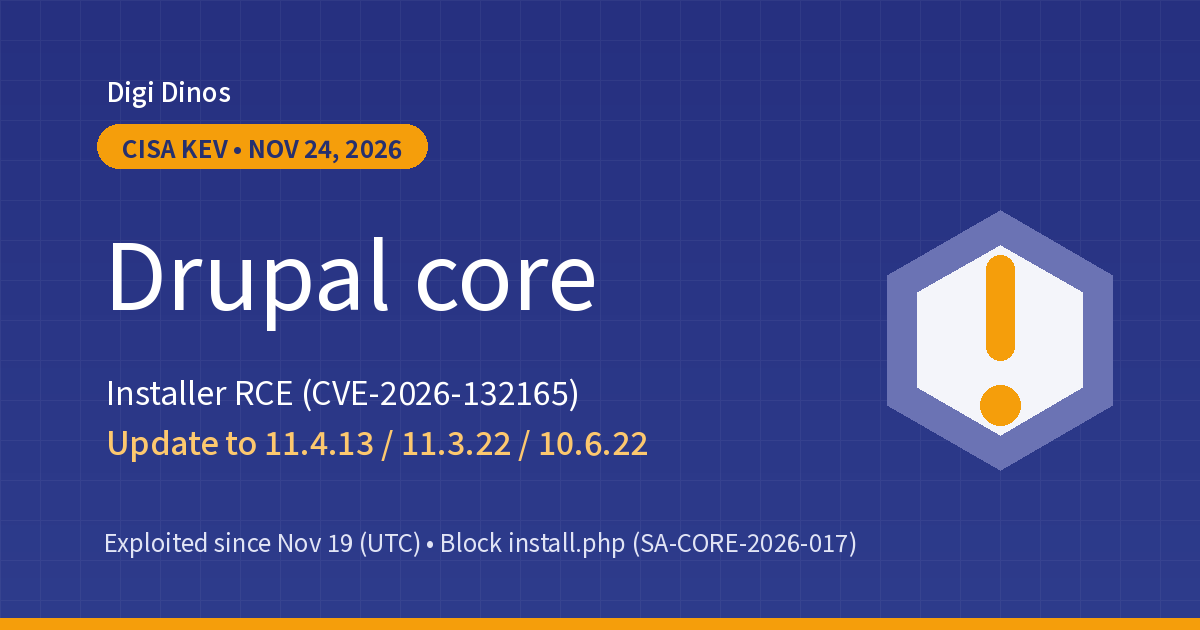
On 18 November 2026 (19 November JST), the Drupal Security Team released fixed versions for CVE-2026-132165, a critical vulnerability in Drupal core (security advisory SA-CORE-2026-017). An attacker can abuse the installation file "install.php" to take over a site or run arbitrary code, and Drupal rates it "Highly critical" (20 out of 25 points). Exploitation in the wild was reported from the day after release, and on 24 November the US CISA added it to its Known Exploited Vulnerabilities (KEV) catalog.
This article is for companies that run their websites on Drupal. It explains the affected versions, the fixed versions, "how to block install.php" if you cannot update right away, and checks to make after updating. Support for Drupal 10 is expected to end in December 2026. Along with this update, decide where you will move next.
Key points of this article
- The fixed versions are 11.4.13, 11.3.22 and 10.6.22 (released 18 November 2026). 11.2 and earlier and 10.5 and earlier are out of support, and no fixed versions will be released for them.
- The Drupal Security Team has added a note that it received reports that the vulnerability was being exploited on real sites by 19:00 UTC on 19 November 2026.
- If you cannot update right away, the official advice is to stop access to /core/install.php in your web server configuration. Keeping it blocked is recommended even after you update.
- The fixed versions have a known issue that causes a "Theme hook … not found" error on some sites. Please check this before updating.
20/25
Risk score of SA-CORE-2026-017 (Drupal's own rating, Highly critical)
About 1 day
From the release of the fixed versions until exploitation was reported
3 days
Deadline CISA set for US federal agencies (added 24 November, due 27 November)
Terms explained
Drupal = an open-source CMS (website management system) written in PHP.
install.php = the file used when Drupal is first set up (/core/install.php). Once setup is finished, it is not normally used.
settings.php = the file that holds important site settings, such as the database connection details.
Remote code execution (RCE) = a weakness that lets someone from outside run any program they like on the server.
KEV = the list published by the US CISA of "vulnerabilities confirmed to be exploited in real attacks".
What happened, and why is it dangerous?
According to Drupal's security advisory (SA-CORE-2026-017), under certain conditions an attacker can use install.php to attempt to "reinstall" Drupal, which could lead to site takeover or remote code execution. CISA's KEV description states that an attacker can do this without logging in (without authentication).
What the "certain conditions" are has not been made public. Drupal explains that if the web server cannot write to settings.php or cannot change its permissions, "some (but not all)" of the attack paths are blocked. In other words, there is no information that lets you say a site is safe because of its configuration. Updating to a fixed version is the baseline.
In its advance notice on 16 November (PSA-2026-11-16), Drupal had already warned that "at least one can be exploited by anonymous users", that "more than one configuration is affected, so do not assume your site is safe", and that "exploits might be developed within hours or days".
Exploitation status (as of 25 November 2026)
The Drupal Security Team has added an update to the advisory: it "has received a report this was exploited on live sites as early as 2026-11-19 19:00 UTC" (04:00 JST on 20 November). CISA added CVE-2026-132165 to the KEV catalog on 24 November and asked US federal agencies to respond by 27 November and to carry out a "forensic check" to determine whether they had been compromised. Its use in ransomware attacks is listed as "unknown".
On the other hand, the official information we checked contains no specific attack methods and no indicators of compromise (IoC) for investigating intrusions. We also found no entry covering this issue in the IPA and JPCERT/CC lists of alerts (checked 25 November).
Affected versions and fixed versions
| Version in use | Fixed version | Security support |
|---|---|---|
| Drupal 11.4.x | 11.4.13 | Until April 2027 |
| Drupal 11.3.x | 11.3.22 | Until December 2026 (when 11.5.0 is released) |
| Drupal 10.6.x | 10.6.22 | Until December 2026 (when 11.5.0 is released) |
| Drupal 11.2.x and earlier, 10.5.x and earlier | No fixed version (out of support) | Ended |
| Drupal 8, 9 | No fixed version (out of support) | Ended |
Note: Support periods are based on Drupal's release notes and the 2 November announcement (PSA-2026-11-02). Drupal 10 itself is also planned to be supported only until December 2026, and 11.3 ends at the same time. If you plan to keep using Drupal next year, you need to move to 11.4 or later. The advance notice stated that development versions (12.0.0-beta3, 11.5.0-beta1) are also affected.
Note: Support for Drupal 7 ended on 5 January 2025. This security advisory did not mention Drupal 7. Whether or not it is affected, an unsupported version leaves other published vulnerabilities unfixed as well.
The same fixed versions also fix one more issue (SA-CORE-2026-018, CVE-2026-132166, Moderately critical). This is a problem with a component (gadget chain) that could become "material" for exploitation when combined with another vulnerability, and Drupal states that it "cannot be exploited directly on its own".
If you cannot update right away: block install.php
As a measure for when you cannot update right away, Drupal advises stopping access to /core/install.php on sites where setup is finished ("Securing the installer (install.php)", updated 21 November). If you keep it blocked after updating too, you will not be affected even if new vulnerabilities are found in the installer in the future.
| Method | Details | Points to note |
|---|---|---|
| Web server configuration (recommended) | For Nginx, location ^~ /core/install.php { return 404; }; for Apache, <Location "/core/install.php"> Require all denied </Location> | In Nginx, an exact match with "=" may not stop /core/install.php/foo. This Apache syntax cannot be used in .htaccess |
| .htaccess (Apache only) | <Files "install.php"> Require all denied </Files> | .htaccess is overwritten when Composer runs. Add the rule with the "append" setting in composer.json |
| Delete the file | Delete core/install.php | It comes back every time core is reinstalled with Composer, so you need a mechanism that deletes it every time |
After blocking, check that all three URLs /core/install.php, /install.php and /core/install.php/foo return 403 or 404. If any returns 200, the block is not working. Be careful not to stop update.php (database updates) as well. For the update status of NGINX itself, see our article on the NGINX vulnerabilities (November 2026).
2 points to know before updating
- Known issue (Theme hook … not found)
An issue has been found in these fixed versions where errors such as "Theme hook field not found" appear on sites that use some modules (such as Search API). Drupal plans to fix it in 11.4.14 and advises that sites that hit this issue on 11.3.22 or 10.6.22 should move to 11.4 now. Please check in a test environment first.
- Behavior changes for new installations
Until now, when the installer could not write to settings.php, it tried to fix the permissions automatically and continue. From the fixed versions on, it shows an error and stops. Existing sites are not affected.
5 steps to check and respond
- List your Drupal sites and versions
Check the version under "Reports" → "Status report" in the admin screen, or with
drush status. Do not forget campaign sites and test sites. - Block install.php
Without waiting for update preparations, stop access to install.php using the methods above. It is not a substitute for updating, but it buys you time.
- Update to a fixed version
If you manage the site with Composer, run
composer update "drupal/core-*" --with-all-dependencies, then run the database update (drush updatedb). Do not forget to take a backup before updating. - Check for signs of intrusion
Look in the web server logs for access to install.php, and check for administrator accounts you do not recognize and for changes to settings.php or unfamiliar PHP files. Because no official investigation method has been published, this is a general check. If you find suspicious signs, please consult a specialist company.
- Check upcoming end-of-support dates
10.6 and 11.3 are expected to end in December 2026. Make your next update plan, including the PHP version. The latest PHP fixed versions are summarized in our article on the November 2026 PHP security release.
What if you leave it? What if you act?
If you leave it as it is
- The site could be taken over without logging in
- Arbitrary programs could be run on the server, which could lead to tampering or data theft
- Exploitation has already been reported, so the site stays an easy target
If you update and check
- The attack path using install.php is closed
- The gadget chain (SA-CORE-2026-018) is fixed at the same time
- You can make a plan for the end of Drupal 10 support
Leave it to Digi Dinos
Digi Dinos is a company that supports DX, security, and system operations and maintenance. We hold ISO 27001 certification, and we also handle server and cloud operations and 24/7 monitoring (NOC). We also update PHP web systems and take over sites built by other companies.
- Current-state check: We check your Drupal version, modules, PHP version, and whether install.php is blocked.
- Update implementation support: We proceed with testing in a test environment, handling known issues, and the production update, following a fixed procedure and schedule.
- Operations handover: We can also take over the operation of sites that have no one to update them after the contract with the web production company has ended.
Even just a question like "Is our Drupal OK?" is welcome (free consultation)
We can help with everything from checking versions to planning the update.
Frequently asked questions
If I block install.php, is it OK not to update?
No. Drupal presents blocking as a measure "if you cannot update right away". Updating to a fixed version is the baseline. Keeping it blocked is recommended even after you update.
Am I safe if settings.php is write-protected?
That cannot be said for certain. Drupal explains that even if the web server cannot write to settings.php or change its permissions, only "some (but not all)" of the attack paths are blocked.
I use Drupal Steward. Do I need to do anything?
According to Drupal, sites that use Drupal Steward are already protected from the known attack paths. However, Drupal advises updating soon in case another path is found.
What should I do with a Drupal 9 or 8 site?
They are out of support, so no fixed versions will be released. First block install.php, then plan a move to a supported version (11.4 or later) as soon as possible. A move often requires reviewing modules and the PHP version, so we recommend consulting early.
Sources (checked 25 November 2026)
- Drupal, "Drupal core - Highly critical - Remote code execution - SA-CORE-2026-017" (18 November 2026, note on exploitation reports added)
- Drupal, "Securing the installer (install.php)" (updated 21 November 2026)
- Drupal, "drupal 11.4.13" release notes (11.3.22 and 10.6.22 released the same day)
- Drupal, "Upcoming critical Drupal core releases on November 18, 2026 - PSA-2026-11-16"
- Drupal, "Security support for Drupal core minor versions reduced to 8 months - PSA-2026-11-02"
- Drupal, "Drupal core - Moderately critical - Gadget chain - SA-CORE-2026-018"
- CISA, "Known Exploited Vulnerabilities Catalog: CVE-2026-132165" (added 24 November 2026)
- IPA: Important security information (FY2026), JPCERT/CC: Security alerts (2026)
Related articles
VMware vCenter CVE-2026-123890: Authentication Bypass

What Is GEO? Getting Recommended by AI Search and AI Agents
PHP Vulnerabilities, November 2026: 7 Critical Flaws and Fixes
GitLab Vulnerabilities, November 2026: Update to 19.6.1
Java4Shell (CVE-2026-114938): Who Is Affected and How to Fix It
NGINX Vulnerabilities: HTTP/2 RCE and Version 1.30.7
Check Point CVE-2026-123039: Exploited with PHP2Shell
Microsoft 365 Outage, November 2026: Cause and Recovery
Microsoft November 2026 Updates: Exploited Outlook Flaw and KBs
OpenSSH CVE-2026-123158: Alpine Login Bypass and What to Do
Japan Data Breaches, Early November 2026: A Summary
Arara Message Breach Update: About 81 Million Email Addresses
SonicWall SSLVPN CVE-2026-19868: MFA Bypass and What to Do
Apache Tomcat Vulnerabilities, October 2026: 8 Flaws and Fixes
.NET 8 and 9 End of Support on 10 November 2026: What to Do
Movable Type Vulnerability JVN#91153973: Update or Mitigate Now
WordPress CVE-2026-119977: Listed as Exploited, Update Now
Japan Data Breaches, Oct–Nov 2026: What Companies Should Check
Ivanti Connect Secure Zero-Days: Update Again and Investigate
GitLab CVE-2026-97229 (CVSS 10): Exploited, Patch Now
Linux Kernel Fragnesia (CVE-2026-46300): Exploited, Patch Now
Brotli Vulnerability CVE-2026-111497 (HTTP2Shell): What to Do
PHP Vulnerability CVE-2026-109618 (PHP2shell): What to Do Now
PHP Upgrade Cost: Moving From PHP 5 or 7 to PHP 8
Taking Over a Legacy System With No Documentation
Node.js Security Release, October 2026: What to Do
Java Vulnerabilities, November 2026: Versions to Install
Securing Legacy Systems: Where to Start (2026 EOL Guide)

Superior Features of ChatGPT 4o (4 Omni)

What Is Digital Transformation? Definition, Roadmap and Examples

The Secret to Happiness!

What Is an IT Comtor? Role, Skills and How It Differs from a BrSE