
NGINX Vulnerabilities: HTTP/2 RCE and Version 1.30.7
Contents8
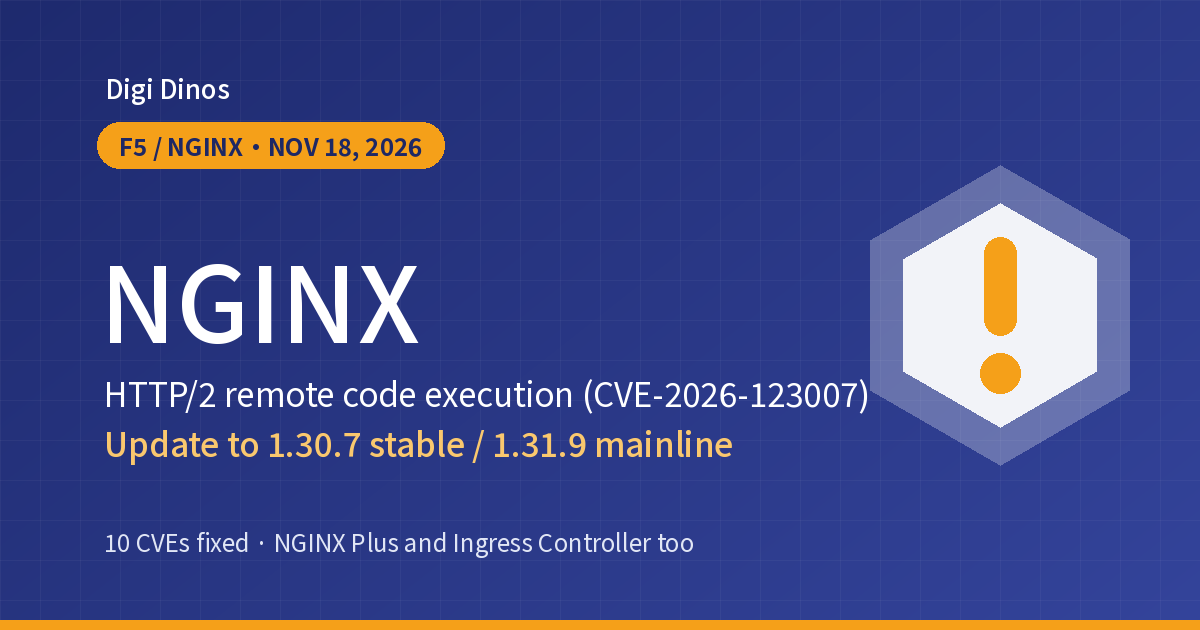
On 18 November 2026, F5, the developer of NGINX, released new versions 1.30.7 (stable) and 1.31.9 (mainline) that fix 10 vulnerabilities. For two of them, in HTTP/2 handling (CVE-2026-123007 and CVE-2026-123633), the researchers who found them say they confirmed that a server can be taken over without logging in. IPA also issued an alert on 19 November.
This article is for companies that use NGINX as the entry point for their websites or APIs. It explains the affected versions, the fixed releases, and workarounds for when you can't update right away. NGINX is often included in shared hosting, cloud services and other products, so check even if you don't remember installing it yourself.
Key takeaways
- The fixed releases are NGINX 1.30.7 (stable) and 1.31.9 (mainline). Almost all earlier versions are affected by at least one of the vulnerabilities.
- The most at risk are servers that have HTTP/2 enabled. For CVE-2026-123007, a takeover has been confirmed even with a setup that only serves static files.
- OS packages (such as Debian's) use different version numbering and may take in only the fixes. Don't judge by the version number alone; check the information from the provider.
- If you can't update right away, you can turn off HTTP/2 for a while, but this does not address all 10 vulnerabilities.
10
Vulnerabilities fixed in the 18 November releases
9.2
Highest severity (F5, CVSS v4.0)
2015
Year of the oldest version affected by CVE-2026-123007 (1.9.5)
Terms used here
NGINX = web server software. It is also widely used as a "reverse proxy" that receives requests and passes them to the app servers behind it.
HTTP/2 and HTTP/3 = newer methods for web communication. Because they make pages load faster, they are enabled on many sites.
Stable and mainline = NGINX has a "stable" line (1.30.x) that only gets fixes, and a "mainline" line (1.31.x) that also gets new features.
Memory corruption = when a program overwrites memory outside the range it is allowed to use. If abused, attackers may be able to run any commands they like from outside.
What are the vulnerabilities, and why are they dangerous?
According to Wiz, one of the finders, both issues are mistakes in memory handling in HTTP/2 processing.
- CVE-2026-123007: the calculation of how much data can be sent at once over HTTP/2 goes wrong, and data is copied into memory outside the allowed range. Wiz says it confirmed a takeover over HTTPS (64-bit) on NGINX that only serves static files (a setup with no app behind it and no extra modules). Versions from 1.9.5 (2015) onward are affected.
- CVE-2026-123633: an HTTP/2 connection is cleaned up while it is still in use. According to F5, this happens in setups that receive HTTP/2 and forward to a server behind it, when the number of connections (worker_connections) runs out.
For both issues, F5 says commands can be run if ASLR (a protection that randomises where things are placed in memory) is disabled or bypassed. Wiz writes that it confirmed a takeover after bypassing ASLR. The problem is in NGINX itself, so you are affected even if the app behind it is built securely.
Note that sources express severity differently. F5 gives 9.2 (critical) in CVSS v4.0 and 8.1 (high) in v3.1, while the list on the official NGINX site rates them "major" (CVE-2026-123007) and "medium" (CVE-2026-123633).
Exploitation status (as of 20 November 2026)
We did not find any mention of actual attacks in the official information from F5, NGINX and IPA that we could check. They are also not in CISA's list of "known exploited vulnerabilities (KEV)" (the 20 November version), which we checked on 21 November. We did not find this issue in JPCERT/CC's list of alerts either.
However, five teams, including Wiz, Rapid7 and Xint, found the same problem separately, and Xint has published a write-up under the name "NGINX2Root". Finish updating before information useful for attacks spreads.
The 10 fixed vulnerabilities and affected versions
We compiled this from the list on the official NGINX site and from the information from F5 and Wiz. "Severity" is F5's CVSS v4.0 score, and "When it occurs" is based on Wiz's explanation.
| CVE | Issue | Severity | When it occurs | Affected versions |
|---|---|---|---|---|
| CVE-2026-123007 | HTTP/2 memory corruption | 9.2 | HTTP/2 is enabled (even within the default settings) | 1.9.5 to 1.31.8 |
| CVE-2026-123633 | HTTP/2 use-after-free | 9.2 | Receiving HTTP/2 and forwarding (proxying) | 1.19.7 to 1.31.8 |
| CVE-2026-121810 | HTTP/3 use-after-free | 9.2 | Receiving HTTP/3 and forwarding | 1.25.0 to 1.31.8 |
| CVE-2026-123634 | Name resolution (resolver) use-after-free | 9.2 | An attacker can control the host name of the forwarding target | 0.6.18 to 1.31.8 |
| CVE-2026-113425 | Mail proxy use-after-free | 9.2 | Used as a mail proxy with auth_http configured | 0.5.33 to 1.31.8 |
| CVE-2026-118899 | Infinite loop while receiving over TLS 1.3 | 8.7 | TLS 1.3 is supported (may cause a service outage) | 1.13.0 to 1.31.8 |
| CVE-2026-120993 | Crash with PROXY protocol v2 | 6.9 | proxy_protocol v2 is used | 1.31.4 to 1.31.8 |
| CVE-2026-125283 | Out-of-range access with alias and try_files | 6.9 | An unusual combination of settings | 0.9.6 to 1.31.8 |
| CVE-2026-123640 | Missing check in ssl_preread | 6.9 | ssl_preread is used | 1.15.2 to 1.31.8 |
| CVE-2026-120967 | Bypass of client certificate checks | 6.3 | Specific SNI settings in stream | 1.25.5 to 1.31.8 |
※ All of them are fixed in 1.30.7 and 1.31.9 (CVE-2026-120993 only affects the 1.31 line).
Fixed releases to install (as of 20 November 2026)
| Product | Fixed release | Information checked |
|---|---|---|
| NGINX (stable) | 1.30.7 | nginx.org (released 18 November) |
| NGINX (mainline) | 1.31.9 | nginx.org (released 18 November) |
| NGINX Plus | 37.3.0.1 and 37.0.8.1 for CVE-2026-123007, 37.2.0.1 and 37.0.7.1 for CVE-2026-123633 | F5 K000163926, K000163928 |
| NGINX Ingress Controller | 5.8.0, 2026-lts-r11 (for the two issues above) | F5 K000163926, K000163928 |
| nginx packages for Debian 12 and 13 | 1.22.1-9+deb12u11, 1.26.3-3+deb13u11 (for the two issues above) | Debian security information |
※ For NGINX Plus and other products, the fixed release differs for each CVE. The table above covers only the two issues we checked in F5's notices. For the other CVEs, check each notice from F5's summary (K000164058).
※ In F5's notices, no fixed release is listed for some products and lines, such as NGINX Plus R34 to R36 and NGINX App Protect WAF, as of 20 November.
※ We have not checked other distributions, such as Ubuntu and Red Hat, one by one for this article. Please check each company's security information.
Five steps to check and respond
- List where NGINX is running
Check web servers, reverse proxies, Kubernetes entry points (Ingress), container images, and NGINX inside products.
- Check the version and where it came from
Check the version with
nginx -v. If it is an OS package, compare the package version with the distribution's security information. - Check the HTTP/2 and HTTP/3 settings
Look for
listen ... http2,http2 on;andquicin the configuration files. Deal first with servers where they are enabled. - Update to the fixed release
After updating, check the configuration with
nginx -tand reload. Also confirm that the old workers have exited. - Watch for suspicious activity
Wiz advises watching for unexpected worker crashes and commands started by NGINX (these are not signs specific to this vulnerability).
If you can't update right away
As a temporary measure for the two HTTP/2 issues (CVE-2026-123007 and CVE-2026-123633), IPA and Wiz describe turning off HTTP/2.
- On NGINX 1.25.1 or later, add
http2 off;to the relevant server block and, in thelistenline, removehttp2(Wiz's steps) - Confirm that the app works before reloading, and confirm that the old workers have exited
- Once the update is done, turn HTTP/2 back on
However, the "Mitigation" field in F5's notices says "None". Also, as IPA's alert notes, there are vulnerabilities in HTTP/3, the mail proxy and other areas, so turning off HTTP/2 alone does not address all 10 vulnerabilities. It is only a stopgap until you update.
Leave it, or act now?
If you leave it
- The server at the entry point of your website may be taken over
- Data from multiple sites and APIs behind it may be stolen
- Your site may be altered, or your service may go down
If you update
- All 10 vulnerabilities are fixed together
- Where NGINX runs and how it is configured are sorted out, which makes the next update easier
- You can review updates for the OS and other software at the same time
The approach to updating the server OS is explained in "Linux kernel vulnerabilities", and the Java vulnerability disclosed around the same time is explained in "Java4Shell (CVE-2026-114938): Who Is Affected and How to Fix It".
How Digi Dinos can help
Digi Dinos is a company that supports DX, security, and the operation and maintenance of systems. We are ISO 27001 certified, and we also handle server and cloud operations and monitoring 24 hours a day, 365 days a year (NOC). Our team works in Japanese.
- Server inventory: we sort out which version of NGINX is running on which servers, and with what settings.
- Support for planning and carrying out updates: even for websites that can't be stopped, we decide the procedure and timing and move forward.
- Taking over monitoring and operations: we can also take over the operation of servers that were managed by another company.
Is your web server safe? Even a simple question is welcome (free consultation).
From checking versions and settings to planning the update, with guidance in Japanese.
Frequently asked questions
We use Apache. Does this concern us?
These vulnerabilities are in NGINX. However, some setups place NGINX in front of Apache, and NGINX may be used inside cloud load balancers. Check your system diagrams and the information for the services you use.
We use shared hosting or a cloud service. What should we do?
NGINX inside a service is updated by the company that provides it. Check the notices from the service provider. NGINX that you installed yourself on a virtual server (such as a VPS or EC2) must be updated by you.
We use Kubernetes ingress-nginx. Are we affected?
F5's notices cover F5's NGINX Ingress Controller. The Kubernetes community's ingress-nginx, which has a similar name, is a separate project, and we have not checked it for this article. Check the version of NGINX it uses in the project's information.
Sources (checked on 20 November 2026)
- nginx, "nginx security advisories"
- nginx, "nginx-1.30.7 stable and nginx-1.31.9 mainline versions have been released" (18 November 2026)
- F5, "K000164058: Out-of-band Security Notification (November 18, 2026)" (updated 19 November 2026)
- F5, "K000163926: NGINX ngx_http_v2_module vulnerability CVE-2026-123007"
- F5, "K000163928: NGINX ngx_http_v2_module vulnerability CVE-2026-123633"
- Wiz, "Unauthenticated Remote Code Execution in NGINX: CVE-2026-123633 and CVE-2026-123007"
- IPA, "Countermeasures for Multiple Vulnerabilities in NGINX (CVE-2026-123007, CVE-2026-123633, etc.)" (in Japanese) (19 November 2026)
- Debian Security Tracker, "CVE-2026-123007"
Related articles
PHP Vulnerabilities, November 2026: 7 Critical Flaws and Fixes
GitLab Vulnerabilities, November 2026: Update to 19.6.1

Java4Shell (CVE-2026-114938): Who Is Affected and How to Fix It

Check Point CVE-2026-123039: Exploited with PHP2Shell
Microsoft 365 Outage, November 2026: Cause and Recovery

Microsoft November 2026 Updates: Exploited Outlook Flaw and KBs

OpenSSH CVE-2026-123158: Alpine Login Bypass and What to Do
Japan Data Breaches, Early November 2026: A Summary
Arara Message Breach Update: About 81 Million Email Addresses

SonicWall SSLVPN CVE-2026-19868: MFA Bypass and What to Do
Apache Tomcat Vulnerabilities, October 2026: 8 Flaws and Fixes
.NET 8 and 9 End of Support on 10 November 2026: What to Do

Movable Type Vulnerability JVN#91153973: Update or Mitigate Now
WordPress CVE-2026-119977: Listed as Exploited, Update Now

Japan Data Breaches, Oct–Nov 2026: What Companies Should Check
Ivanti Connect Secure Zero-Days: Update Again and Investigate
GitLab CVE-2026-97229 (CVSS 10): Exploited, Patch Now

Linux Kernel Fragnesia (CVE-2026-46300): Exploited, Patch Now

Brotli Vulnerability CVE-2026-111497 (HTTP2Shell): What to Do

PHP Vulnerability CVE-2026-109618 (PHP2shell): What to Do Now
PHP Upgrade Cost: Moving From PHP 5 or 7 to PHP 8

Taking Over a Legacy System With No Documentation
Node.js Security Release, October 2026: What to Do
Java Vulnerabilities, November 2026: Versions to Install
Securing Legacy Systems: Where to Start (2026 EOL Guide)

Superior Features of ChatGPT 4o (4 Omni)

What Is Digital Transformation? Definition, Roadmap and Examples

The Secret to Happiness!

What Is an IT Comtor? Role, Skills and How It Differs from a BrSE